Research
Linking how lithium-ion batteries degrade to irreversible expansion, the permanent thickness growth it causes, and building the measurements that make that link usable.
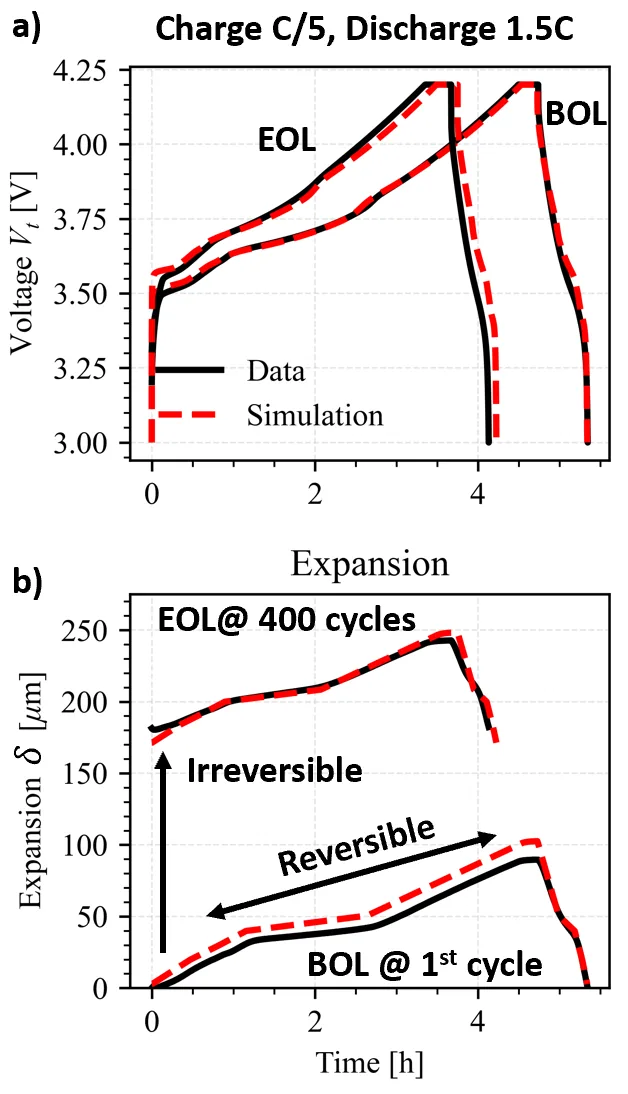
My thesis established that irreversible expansion, and the reversible expansion on top of it, can be predicted from degradation mechanisms in multi-layer pouch cells, and parameterized that link. The work below spans the modeling, the measurement hardware, and the estimation methods that came out of it. Supported in part by General Motors and the National Science Foundation.
Degradation modeling
The problem
A cell loses capacity, gains resistance, and grows permanently thicker as it ages: irreversible expansion, with the reversible expansion of every charge on top. These are usually modeled separately, with a different parameter set for each, which means none of them predicts the others.
What I built
I built a physics-based model that predicts all three from a single consistent tuning, connecting irreversible expansion to the mechanisms behind it. Under gentle cycling most of it is SEI growth; under fast charging, lithium plating takes over. It holds up on cycling conditions it was never trained on.
- Consistently tuned battery lifetime predictive model of capacity loss, resistance increase, and irreversible thickness growth · JES 171(1) 010532
- Degradation and expansion of lithium-ion batteries with silicon/graphite anodes: Impact of pretension, temperature, C-rate and state-of-charge window · eTransportation 24
- Model code and figure notebooks for the 2024 JES paper · GitHub
Expansion sensing
The problem
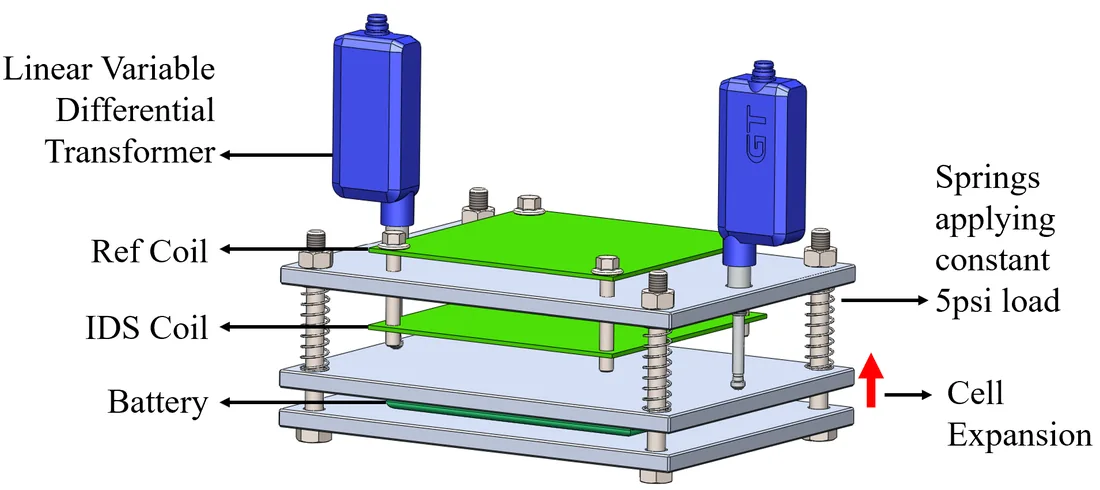
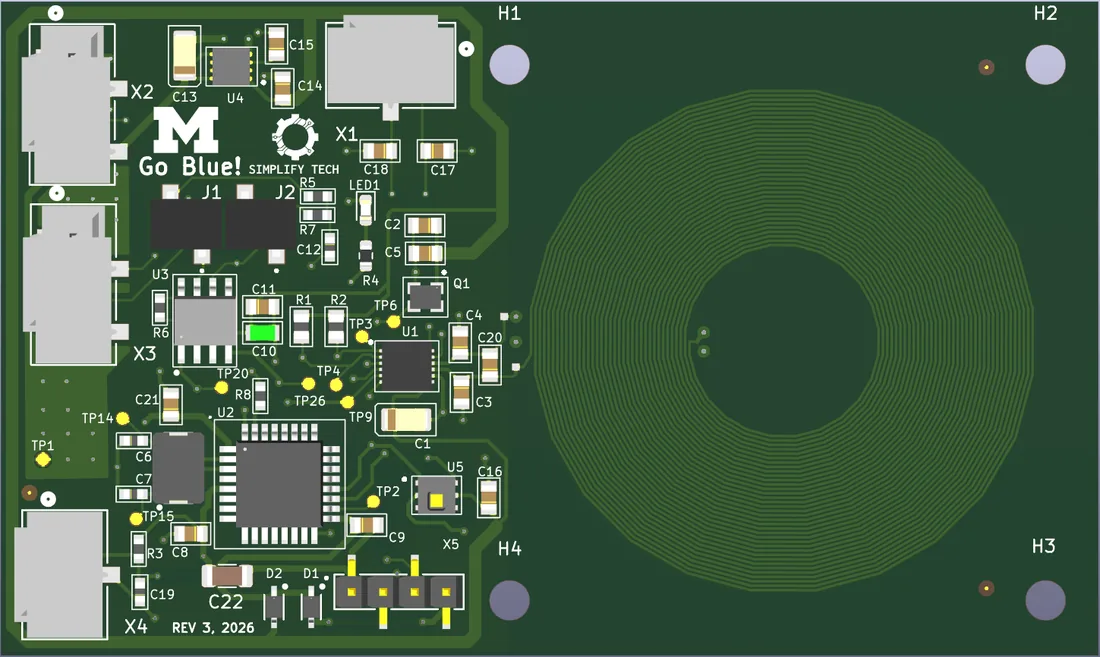
Measuring cell thickness during cycling normally needs an LVDT at roughly $2,000 per channel. At that price you instrument a handful of cells, so expansion stays a curiosity rather than a diagnostic.
What I built
I designed an inductive sensor and constant-pressure fixture costing under $20 that tracks thickness to within about 3 µm of a $2,000 LVDT. We deployed 120 of them and monitored 100+ cells simultaneously for two years.
Accelerated aging simulation
The problem
Simulating a battery through its whole life at full physical fidelity takes minutes to hours, which is too slow to sit inside a design loop or an optimizer that needs thousands of runs.
What I built
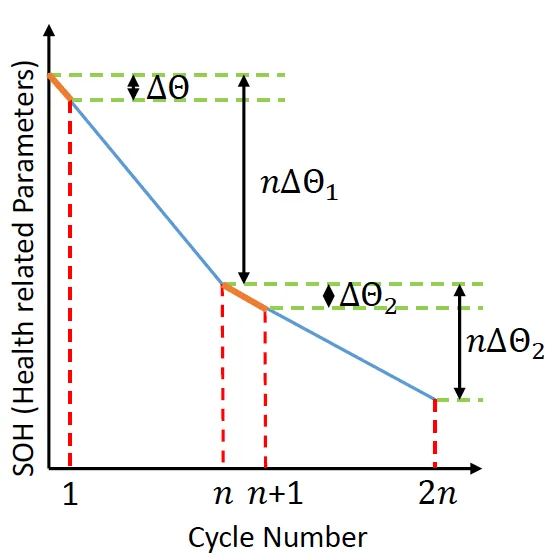
I developed a method that resolves degradation within a cycle but extrapolates adaptively between cycles, cutting lifetime simulation to seconds, one to two orders of magnitude faster, without discarding the intra-cycle physics.
State estimation and control
The problem
The things you actually want to know (how much lithium has plated, how each electrode is aging) are not directly measurable, and the model parameters drift as the cell ages.
What I built
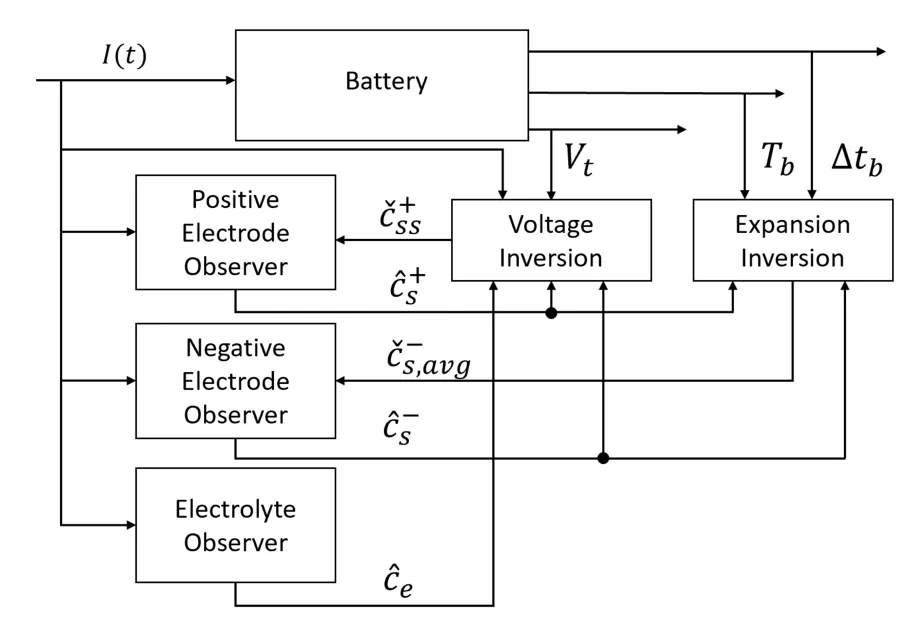
I built nonlinear observers that estimate internal state from voltage, temperature, and thickness together, under the parameter uncertainty that aging introduces, and applied the same signals to detect internal short circuits early.